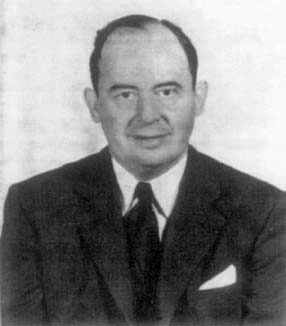
John von Neumann was born on 28 December 1903 in Budapest, Hungary.
János Neumann learned to one of the best secondary schools in Hungary. His extraordinary talent for mathematics was recognised by his teacher László Rátz, who encouraged János to take extra classes in mathematics. During his grammar school years, János had classes from József Kürschák, Mihály Fekete and Gábor Szegô. János won the Award for the Best Student in Mathematics in Hungary in 1920.
He continued his studies at the Faculty of Arts of the Budapest University from September 1921. His major was mathematics, the minors were physics and chemistry. He was also highly interested in engineering, therefore he simultaneously studied at the University of Berlin between 1921 and 1923. From 1924 he also studied at the Technische Hochschule in Zurich, where he completed a degree as chemical engineer. He was just a little more than 22 when he received his PhD degree in mathematics at the University of Budapest. His thesis was titled "The axiomatic deduction of general set theory".
In the autumn of 1926 he travelled to Göttingen where he gave an outstanding lecture on game theory in the institute of mathematics. He was lecturer at the department of mathematics of the Friedrich Wilhelm University in Berlin. During this period his name became famous for his publications on set theory, algebra and quantum mechanics.
In 1929, the University of Princeton invited John von Neumann as visiting lecturer. A year later he was appointed professor of the university. For three years taught one semester in Europe, one in Princeton. When Hitler gained power in 1933, von Neumann emigrated to the United States where he received citizenship in 1937.
As part of his work in physics, in the mid-30's he started studying turbulent flow beyond the speed of sound. He was invited to the Ballistic Research Laboratory in 1937 as an eminent expert on shock waves. Being an emigrant Jew himself, he felt compelled to join the Manhattan Project aiming to combat Nazism.
In 1945 he was appointed, and remained until the day of his death on 8 February 1957, manager of the Electronic Computer Project in Princeton. His interests turned toward the modelling of the nervous system and the human brain. He received considerable help from Herman Goldstine and J. Presper Eckert, Jr., leaders of the ENIAC project.
Still in 1945, in his paper "First Draft of a Report on the EDVAC" Jonh von Neumann stated those basic principles on the logical structure of computers that are known as "Neumann principles" ever since:
application of the binary system,
the computer should operate fully electronically,
use of arithmetical unit
use of a central processing unit and an ,
program controlling and data storage.
He was the one who introduced the system of symbols to describe the logical structure of computers. The significance of this symbolism is comparable to the system of mathematical symbols.
In 1956, he was awarded the Presidential Medal of Freedom by President Eisenhower.