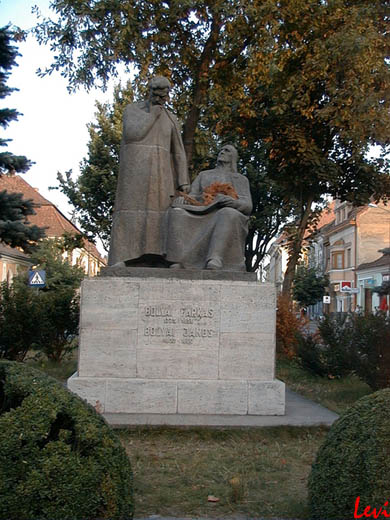
Janos Bolyai (December 15, 1802 - January 27, 1860) was born in Kolozsvar, Transylvania, at that time a Hungarian Grand Duchy ruled by the Hapsburgs, and died in Marosvasarhely, Transylvania. Janos Bolyai, son of Farkas Bolyai, the famous professor of mathematics, physics and chemistry at the Reformed College in Marosvasarhely, as a teenager set himself to resolve the 2000 year old geometry problem, intensively researched also by his father: To prove Euclid's fifth, the so called parallel postulate from Euclid's others.
The fifth postulate requires that given a line in the plane and a point outside of it, there exists exactly one line through the point that is parallel to the line. After he had recognized the impossibility of this task, he developed absolute geometry that is independent of the fifth postulate and also hyperbolic geometry where this postulate is negated in such a way that infinitely many parallels are assumed to exist through the given point to the given line.
He was only 21 years old when he reported his findings to his father: "I have discovered things so wonderful that I was astounded... out of nothing I have created a new, different world." Bolyai's geometry made possible the creation of modern physical theories in the 20th century. Bolyai also developed a rigorous geometric concept of complex numbers as ordered pairs of real numbers.
Although he never published more than the 26-page Appendix, mainly because he was unable to gain recognition for his work, he left 3,000 pages of mathematical and 11,000 pages of other manuscripts when he died. Quite recently the mathematical manuscripts have been thoroughly researched with surprising success: 'mathematical gems' have been found in them, mainly results in number theory which were new in Bolyai's time.
Link:
Mathematical Stamps
Biography:
http://www.mathdaily.com/lessons/J%E1nos_Bolyai
Authority:
Amerikai Magyar Alapítvány-American Hungarian Foundation